

Mon–Thu 8am–4:30pm CT · Fri 8am–3pm CT
Theranostic Components — The Ligand
The Ligand
The molecule that finds the cancer and delivers the payload.
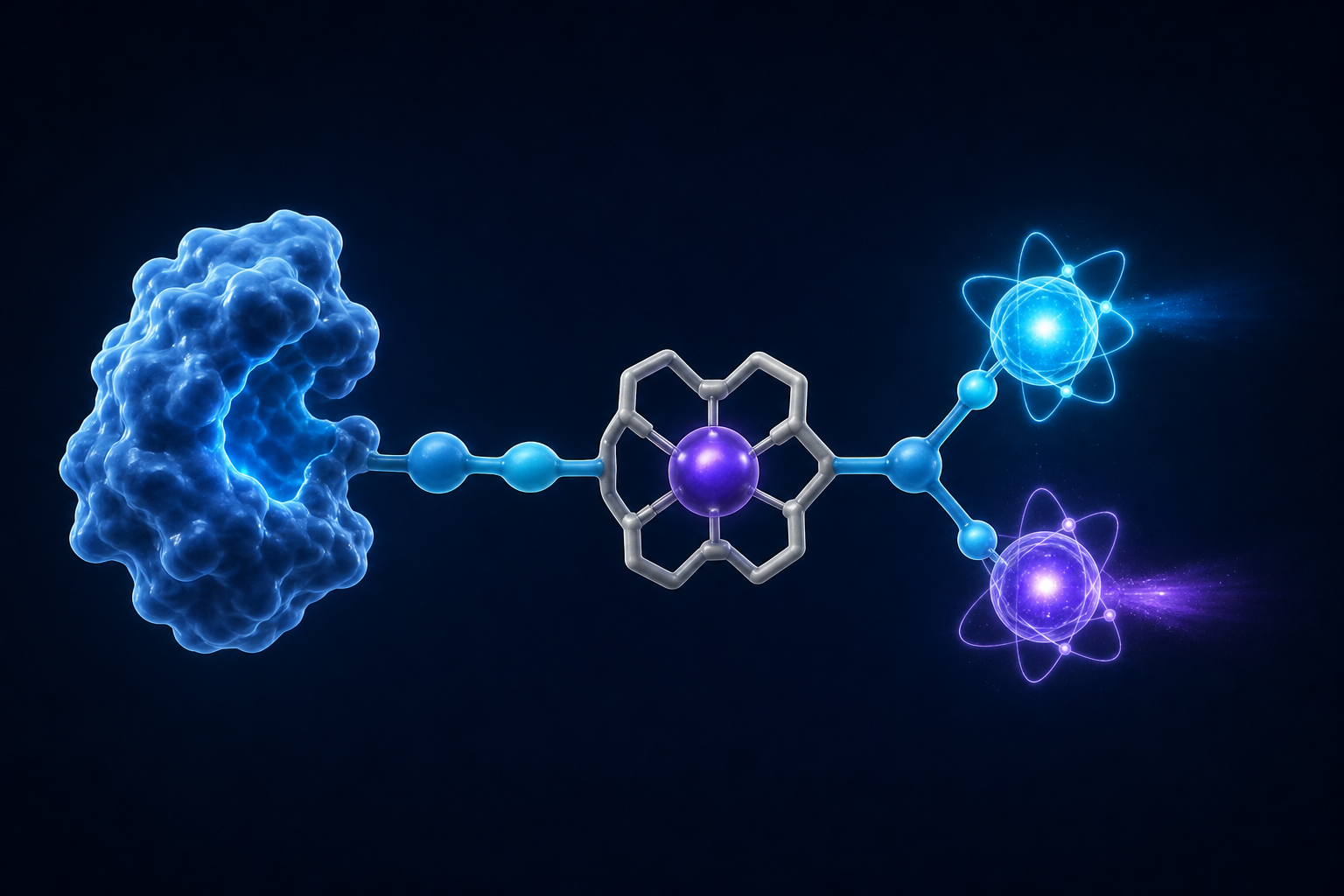
If the radiopharmaceutical is a delivery truck, the ligand is the truck itself — set to the cancer’s exact address, carrying whatever the mission requires.
Start here
What a ligand is
Ligand
The targeting molecule that carries a radioactive isotope and delivers it to a specific site on a cancer cell — the target. In radiopharmaceuticals the ligand is most often a small molecule, a peptide or small protein, or an antibody, each with distinct advantages in specificity, tissue penetration, and therapeutic effect.
Where it fits
The ligand is the truck
In the truck analogy XCancer uses across this site, the whole radiopharmaceutical is a delivery truck. The ligand is the truck itself — the part that knows the destination and drives there.
It is set to a specific GPS coordinate: the cancer target. Whatever the truck is carrying — light bulbs to image the tumor, or a payload to treat it — the ligand is what actually finds the cancer and pulls up to it.
Why the ligand matters
Targeting the cancer, sparing the healthy
Radiation has long been a cornerstone of cancer treatment, damaging the DNA of cancer cells until they die. The problem is that traditional radiotherapy can harm healthy tissue too. The ligand is the answer to that problem: by attaching the radioactive isotope to a molecule that seeks out cancer specifically, the radiation is carried to the tumor and away from normal cells.
The most common ligands are small molecules, peptides, and antibodies. Each is a different size with a different personality — and the choice shapes how well the drug targets, how deeply it penetrates, how long it lingers, and how safe it is.
Three modalities
The three kinds of ligand
Think of them as small, medium, and large — a spectrum that trades size against specificity and staying power.
Small molecule
Compact organic compounds that can be radiolabeled and designed to bind specific receptors or antigens on cancer cells. Their simple structure is easy to synthesize in many versions, they clear the body quickly, and their tiny size lets them penetrate tissue and reach less-accessible spots like an enzyme’s active site. They are the backbone of PET imaging and much targeted radionuclide therapy.
Strengths
Simple to make and vary · rapid clearance · deep tissue penetration · reaches hard-to-access sites
Trade-offs
Small size limits target interaction and specificity — a challenge when healthy tissue carries related proteins. Liver toxicity from the drug or its metabolites must be watched closely.
Peptide or small protein
Short chains of amino acids (or small proteins like antibody fragments) that strike a balance between the small size of small molecules and the high specificity of antibodies. They can be built to bind receptors overexpressed on cancers — like somatostatin receptors in neuroendocrine tumors — with high affinity. Their moderate size gives effective tissue penetration and efficient entry into cells while keeping specificity high. ¹⁷⁷Lu-DOTATATE is a clinically successful example.
Strengths
High affinity and specificity · effective penetration · efficient cell internalization · manageable off-target effects
Trade-offs
The binding partner must be unique to cancer — if it also sits on healthy cells, they get irradiated too. Truly cancer-specific targets are limited, and many already have drugs.
Antibody
Monoclonal antibodies are large proteins that recognize and bind tumor-associated antigens with unmatched specificity and affinity, and can even engage the patient’s own immune system against the cancer. They are used for both imaging and therapy (radioimmunotherapy). But their large size limits tissue penetration, and their long circulation time — an asset in many drugs — becomes a liability in radiotherapy.
Strengths
Exceptional target specificity and affinity · engages the immune system · works for imaging and therapy
Trade-offs
Prolonged circulation of the isotope damages healthy tissue and can deplete immune cells, so radiolabeled antibodies are often held to low doses or limited to imaging. Peptides are usually preferred for therapy.
Side by side
Size versus specificity versus staying power
No modality is universally best — each is a set of trade-offs the designer balances against the target and the isotope.
Modality traits at a glance
| Features | Small Molecules | Peptides / Small Proteins | Antibodies |
|---|---|---|---|
| Summary | Rapid penetration and clearance with the potential to target intracellular proteins and small binding sites. | Balanced approach with high specificity and affinity, favorable circulation times, and flexibility for imaging and therapy. | Unmatched specificity and affinity with a proven track record, but slower clearance limits suitability for radiotherapy. |
| Size | Small | Small to Medium | Large |
| Applications | Imaging & Therapeutic | Imaging & Therapeutic | Primarily Therapeutic (Imaging less ideal) |
| Target Specificity | + | ++ | +++ |
| Tissue Penetration | +++ | ++ | + |
| Clearance | Rapid (renal clearance) | Moderate (renal clearance) | Slow (prolonged circulation) |
| Metabolism | Enzymatic metabolism may alter drug | Enzymatic degradation possible (sequence dependent) | Catabolized like native antibodies |
| Target Diversity | Limited | Moderate | Broadest (virtually any antigen) |
| Ability to Modify | High (chemistry rich) | Moderate to High | Challenging (complex engineering) |
| Chelator & Isotope Diversity | Wide range | Wide range | Wide range |
| Immunogenicity Risk | Low | Moderate (protein based) | Low (humanized mAbs) |
The same target and the same radioisotope can perform very differently depending on the ligand carrying them. The ligand is not just packaging — it is a decisive part of how well a theranostic works.
Why it matters to patients
The ligand shapes your experience
Because the ligand controls how fast the drug reaches the tumor and how quickly it leaves the body, it directly affects how much radiation healthy tissue receives — and therefore your side effects and safety precautions.
A fast-clearing small-molecule or peptide ligand generally means a shorter window of exposure. A long-circulating antibody may deliver more to the tumor but requires more care afterward. Your team chooses the ligand with this balance in mind.
Emerging technology
Bispecific antibodies and pre-targeting
The newest advances aim to break the biggest limit of all — that one drug binds one target. Bispecific antibodies can bind two different targets at once, and multi-specific antibodies three or more. In cancer this is powerful two ways: it lets one antibody hit several targets, or it sharpens precision so the drug only sticks to cells displaying two or more cancer markers together.
Two targets at once
Binding two markers simultaneously means the drug engages only cells that show both — a combination healthy tissue rarely has — widening the safety margin.
Pre-targeting
A non-radioactive agent is given first and finds the tumor. A radioligand given afterward binds to it — so radiation spends far less time circulating in healthy tissue.
One example is the SADA platform (Self-Assembling and Disassembling bispecific antibodies). A small antibody fragment can be aimed at almost any tumor antigen and coupled to a domain that grabs a single, universal radioligand — so the same radioactive component can pair with many different tumor-targeting fragments.
Combining the specificity and potency of multi-specific antibodies with radioligands is an active frontier. It promises to pre-target radiation to a wider range of cancers — and lower the chance that cancer cells escape treatment.
On the frontier
Cutting-edge ligand research
Ligand design is one of the fastest-moving areas in cancer medicine right now. A few directions stand out in current research and trials:
Engineered antibodies that clear fast
The classic antibody problem is slow clearance and liver retention. New engineered formats — antibody fragments, minibodies, and nanobodies, plus full antibodies redesigned to switch off their natural recycling — aim to keep an antibody’s pinpoint targeting while clearing as quickly as a small molecule, cutting the dose to healthy tissue.
AI-designed ligands
Computational and AI methods are now designing and optimizing ligands — increasing tumor uptake, retention, and the tumor-to-healthy-organ ratio — with AI-designed antibodies reaching binding strengths competitive with those found the traditional way.
Radiohybrid & albumin-tuned ligands
Newer PSMA ligands add an albumin-binding moiety so the drug lingers long enough to load the tumor, paired with a “competitor” that can dial blood levels back down — tuning how long the ligand circulates to raise tumor dose while sparing healthy tissue.
Ligands built for alpha & Auger
Long-circulating ligands like SibuDAB are being paired with terbium-161 — which adds Auger electrons to beta radiation — and antibodies are being matched with actinium-225 alpha-emitters, designing the ligand around the isotope’s reach for microscopic disease.
New molecular targets
Beyond PSMA and somatostatin, ligands are being built for a fast-growing list of targets — FAP, GRPR, CAIX, HER2, FRα, B7-H3, and PD-L1 among them — extending radioligand therapy to many more cancer types.
Antagonist-based peptides
Newer peptides work by blocking a receptor rather than activating it — like nastorazepide-based ligands for the CCK2 receptor in medullary thyroid cancer and small cell lung cancer — which can bind more sites per cell and improve targeting.
Radioligand therapy moved from niche to mainstream in 2025, with clinical-stage programs now spanning more than 25 molecular targets across over 20 tumor types. The ligand is where much of that expansion is being engineered.
In summary
One target is the shared limit
The choice among small molecules, peptides, and antibodies depends on the patient’s health, the tumor, and the treatment goal — each brings unique strengths, and ongoing research keeps refining them to maximize effect while sparing healthy tissue.
But every standard modality shares one shortfall: one drug binds one target type. That 1:1 relationship means target expression on healthy tissue is a safety concern, and loss of the target on cancer cells can render the drug inactive. This is exactly why multi-specific and pre-targeting approaches hold such promise — reaching more targets, and giving cancer fewer ways to escape.
Keep going
The other components
The ligand is one part of a molecule with several. Each one is chosen for a reason.
Share your feedback
Help us improve your experience