

Mon–Thu 8am–4:30pm CT · Fri 8am–3pm CT
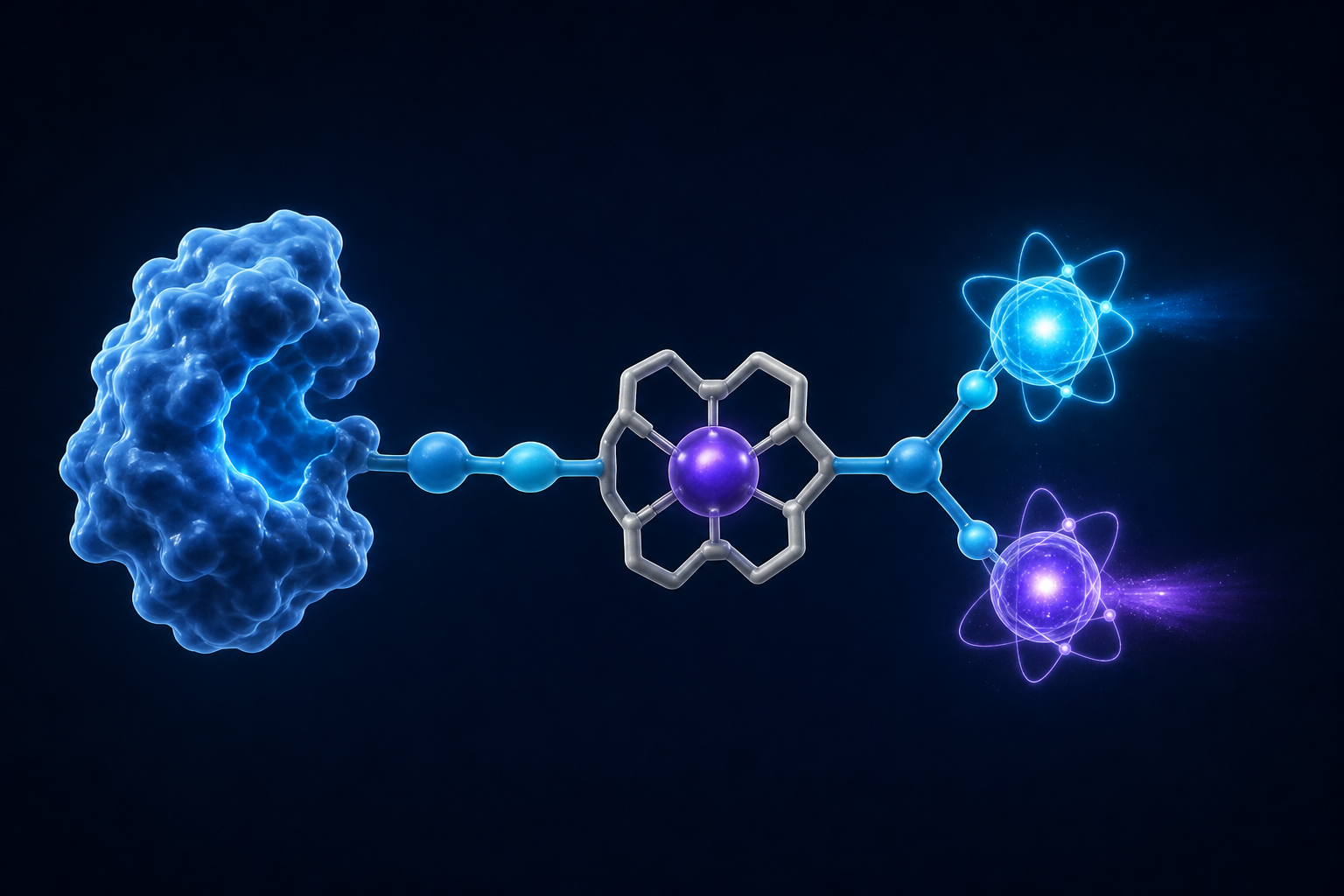
Theranostic Components — The Radioisotope
The Radioisotope
The cargo the truck carries — light bulbs to see the cancer, or a payload to treat it.
Same truck, same target, same route. Load light bulbs and you image the tumor; load a therapeutic payload and you destroy it. The radioisotope is what makes theranostics a matched pair.
Start here
What a radioisotope is
Radioisotope
A radioactive atom undergoing radiation decay to become stable and non-radioactive. Depending on the type of energy it releases during that decay, it can be used either to image cancer or to treat it.
Where it fits
The radioisotope is the cargo
The ligand is the truck, the linker is the hitch, the chelator straps the load down. The radioisotope is the cargo the truck is carrying — and it comes in two kinds.
Load the trailer with light bulbs or imaging radioisotopes and the truck lights the tumor up for a scan. Load it with a therapeutic isotope payload and it destroys the tumor instead. Same truck, same target, same route — you simply swap what's in the trailer. That single idea is the heart of Theranostics.
Two jobs
Light bulbs to see, payloads to treat
Every radioisotope in theranostics falls into one of these two roles, decided entirely by the kind of radiation it gives off as it decays.
SEE
Diagnostic isotopes — the light bulbs
These give off radiation that escapes the body and is caught by a scanner, revealing exactly where the cancer is. Positron and gamma emitters like gallium-68 and fluorine-18 do this job. They light the tumor up; they don't harm it.
TREAT
Therapeutic isotopes — the payloads
These give off radiation that stays put and deposits its energy right in the tumor, breaking cancer-cell DNA. Alpha and beta emitters like lutetium-177 and actinium-225 do this job. They destroy the tumor from within.
The radiation types
How to read the payload
The kind of radiation an isotope emits decides whether it sees or treats, how far its energy travels, and what precautions you'll need. Our dedicated radiation page breaks each type down in detail.
| Radiation | Job | Reach | Example isotope |
|---|---|---|---|
| Alpha | Treat | A few cell-widths — very powerful, very local | Actinium-225 |
| Beta | Treat | A few millimetres — good for larger tumors | Lutetium-177 |
| Auger | Treat | Billionths of a metre — must be inside the cell | Terbium-161 |
| Gamma | See | Exits the body to a camera | Technetium-99m |
| Positron | See | Exits the body for a PET scan | Gallium-68 |
The same target reached by the same ligand can be used to see or to treat — the only thing that changes is the radioisotope riding in the trailer. That is what makes theranostics a matched pair.
Why the differences matter
How each type damages DNA
Radiation kills a cancer cell by damaging its DNA badly enough that the cell cannot repair itself. But the kind of damage matters as much as the amount — and this is where alpha, beta, and Auger part ways.
DNA is a double helix — two strands. A break in just one strand is a single-strand break, and cells repair these routinely using the intact strand as a template. A break in both strands at the same spot is a double-strand break — far harder to fix, and when several cluster together, often impossible. Double-strand breaks are what actually kill the cell.
The deciding factor is how densely a particle deposits its energy as it travels — what physicists call linear energy transfer, or LET. A particle that dumps its energy in a tight, concentrated track tears through both strands at once. One that spreads its energy thinly leaves mostly scattered, repairable nicks.
| Property | Beta & gamma (low density) | Alpha (very high density) | Auger (high density, tiny range) |
|---|---|---|---|
| Energy deposit | Sparse, spread along a long path | Dense, concentrated in a short track | Extremely dense, in a nanometre-scale cluster |
| Main DNA damage | Mostly single-strand breaks & base damage | Clustered double-strand breaks | Clustered double-strand breaks — if next to the DNA |
| How the cell copes | Repairs most damage; needs many hits to overwhelm it | Damage is often too complex to repair | Damage too complex to repair, but only if delivered into the nucleus |
| Roughly how lethal | Takes many crossings to kill a cell | A single well-placed track can be enough | Very high, but only at point-blank range to DNA |
| Needs oxygen to work? | More dependent (works largely through free radicals) | Less dependent (damages DNA directly) | Less dependent (damages DNA directly) |
To put rough numbers on it: with low-density radiation like beta and gamma, DNA picks up something like 1,000 single-strand breaks for every 20–30 double-strand breaks — a lot of damage, but mostly the repairable kind, so it takes many particle crossings to finish a cell off. A single alpha track, by contrast, can create the kind of clustered double-strand break that ends a cell in one well-placed hit.
This is the whole strategic picture in one idea. Beta reaches across many cells but works gently, so it suits bulkier tumours where cross-fire helps. Alpha and Auger hit ferociously but over a tiny range, so they suit scattered single cells and microscopic disease — as long as the ligand delivers them right where they need to be.
Quick reference
The particles and their isotopes
Two tables to keep the whole landscape straight: the therapeutic particles that treat cancer, and the imaging particles that reveal it. The best-known theranostic isotopes are listed under each.
Therapeutic — the payloads that treat
| Particle | Reach in tissue | DNA damage | Best suited to | Key isotopes |
|---|---|---|---|---|
| Alpha | Under 0.1 mm — a few cell widths | Dense, clustered double-strand breaks; a single hit can be lethal | Scattered single cells & microscopic disease | Actinium-225 · Lead-212 · Radium-223 · Astatine-211 · Bismuth-213 |
| Beta | 1–10 mm — hundreds of cell widths | Sparse single-strand breaks; needs many hits, but cross-fires neighbours | Bulkier tumours & cell clusters | Lutetium-177 · Yttrium-90 · Iodine-131 · Copper-67 · Terbium-161* |
| Auger | Billionths of a metre — sub-cellular | Intense clustered breaks, but only at point-blank range to DNA | Single cells, when delivered into the nucleus | Terbium-161 · Copper-64* · Indium-111 · Iodine-125 |
*Some isotopes do more than one job. Terbium-161 is a beta emitter that also releases Auger electrons — a "beta-plus-Auger" agent. Copper-64 both images (positron) and delivers Auger electrons. This overlap is exactly what makes them interesting.
Imaging — the light bulbs that reveal
| Particle | Scan type | How it works | Strengths | Key isotopes |
|---|---|---|---|---|
| Positron | PET | Emits a positron that produces two photons detected in coincidence | High resolution & sensitivity; finds small tumours | Gallium-68 · Fluorine-18 · Copper-64 · Zirconium-89 · Scandium-44 |
| Gamma | SPECT / gamma camera | Emits gamma rays that pass out of the body to a rotating camera | Widely available; can image during & after therapy | Technetium-99m · Indium-111 · Iodine-123 · Lead-203 · Copper-67 |
The magic of theranostics is matched pairs: image with one isotope, treat with its chemical twin. Gallium-68 images and Lutetium-177 treats. Copper-64 images and Copper-67 treats. Lead-203 images and Lead-212 treats — the same targeting, the same chemistry, just a different payload.
A closer look
Auger emitters — the tiniest reach of all
Alpha and beta get most of the attention, but a third therapeutic type is drawing intense research interest: the Auger emitter (pronounced “OH-zhay”). These isotopes release a shower of very low-energy electrons that travel an almost unimaginably short distance — just billionths of a meter, far less than the width of a single cell.
That extreme range is the whole point. Because the energy dissipates so close to its source, an Auger emitter does almost nothing unless it is delivered inside the cancer cell — ideally right up against the DNA in the nucleus. Get it there, and it damages the tumor cell with extraordinary precision while leaving neighbouring healthy cells virtually untouched.
STRENGTH
Pinpoint precision
Damage is confined to the cell that takes the isotope up — potentially the least collateral harm of any radiation type.
CHALLENGE
Getting inside
The payload must be carried into the cell and close to the nucleus, so research pairs Auger emitters with targets that sit near the DNA, such as PARP.
Auger-emitting therapy is still largely in trials, being explored in cancers like glioblastoma, prostate, and neuroendocrine tumors. It represents some of the most precise radiation medicine has ever attempted.
Explore Isotopes
The radioisotopes of theranostics
The cargo the truck can carry — light bulbs to see cancer, or a payload to treat it. Filter by job, by emission, or search by name.
All isotopes
0 shown
This directory covers the well-established theranostic isotopes for education. New isotopes enter trials constantly — for the full current list your site maintains, see the link below. Emissions and half-lives are approximate and for learning, not clinical use.
Go deeper
See every isotope under study
New radioisotopes are entering clinical trials around the world all the time. TheranosticTrials.org maintains the full, current list of the radioisotopes being studied today, alongside the other RLT components.
Why it matters to patients
The payload sets your precautions
Because different isotopes emit radiation that travels different distances, the type you receive determines the safety steps afterward.
After a beta agent, you may be asked to keep some distance from others for a few days. After an alpha agent — whose radiation can't even pass through skin — you can often be near people right away, though you may be told to take simple steps like flushing twice. Your team will give you instructions specific to your isotope.
What's coming
New isotopes, matched pairs
Alpha therapy
Actinium-225 and other alpha-emitters deliver intense, ultra-local damage and are among the most promising areas in the field.
True theranostic pairs
Matching an imaging isotope with a therapy isotope on the same ligand, so the scan that finds the cancer predicts how treatment will behave.
Better supply
New production methods aim to make scarce isotopes more widely available to patients.
Auger emitters
Ultra-short-range isotopes being studied to damage cancer cells with extreme precision when delivered inside them.
Share your feedback
Help us improve your experience