

Mon–Thu 8am–4:30pm CT · Fri 8am–3pm CT

Patient Education — Basics of Theranostics
How Theranostics Work
Imaging and treating the very same target — the heart of precision cancer medicine.
Theranostics pairs a PET scan that finds the cancer with a therapy that destroys it, both aimed at the same marker. Here is how the pieces fit together.
Start here
What theranostics means
Theranostics
Two words in one: THERApeutics — a targeted radioligand therapy — and diagNOSTICS — a diagnostic isotope read on a PET scan. Theranostics pairs a radioactive isotope with a construct built to travel to one specific target on cancer cells.
If the isotope has properties that locate a cancer cell, it is diagnostic molecular imaging — a PET scan. If it has properties that kill a cancer cell, it is radioligand therapy. Either way, the isotope is linked to a ligand set to find a specific target on the cancer.
That is the whole idea of precision medicine here: image and treat the same target. The scan that finds the cancer and the therapy that destroys it are aimed at the very same marker.
The five parts
Parts of a theranostic
Every theranostic — imaging or therapy — is built from the same five components: ligand, linker, chelator, radioisotope, and target.
Chelator
Securely holds the radioisotope in place, like strap tie-downs on a cargo truck — preventing premature release and helping determine that release happens at the target.
Radioisotope
A radioactive atom decaying toward stability. Depending on the energy it releases, it is used either to image cancer or to treat it.
Linker
Connects the ligand to the radioisotope, like a hitch on a truck. It keeps the therapy stable in circulation, prevents the isotope releasing too early, and ensures efficient release at the target.
Ligand
A molecule that binds the radioisotope and delivers it to a specific site on the surface of a cancer cell — the target. It can be an antibody or a small molecule.
Radioligand target
The marker on the cancer. Its specificity and abundance decide how well the cancer shows on a scan and how well therapy works. A highly specific target means fewer side effects; PSMA, for example, is a strong prostate target but also sits on salivary glands, which can cause dry mouth.

Helpful analogy
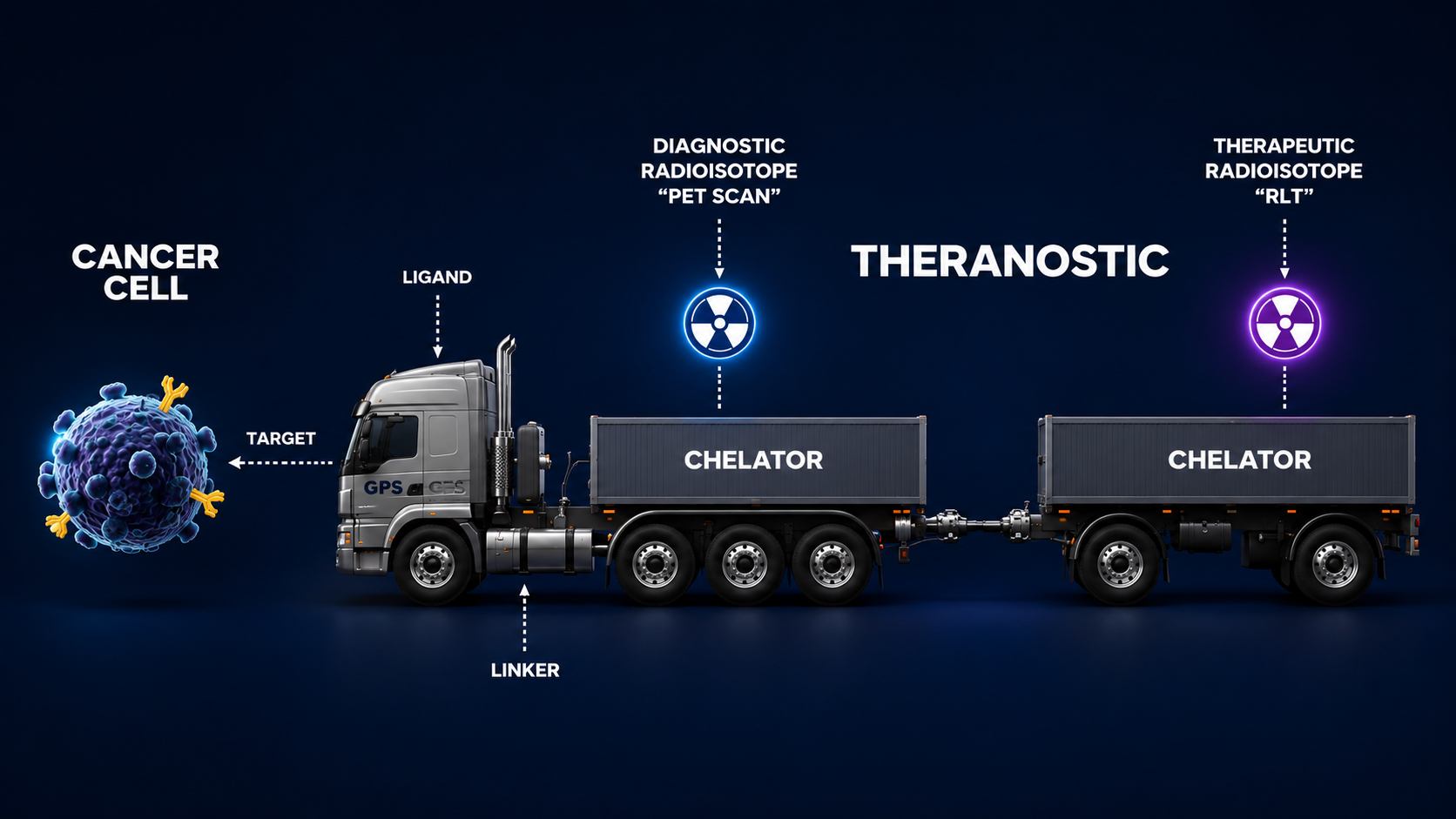
Think of it like a truck and trailer
A simplified way to picture it: a truck hitched to a trailer. Each part of the drug plays a role in the journey.
Target
The specificity and abundance of the target on the cancer cells determine the effectiveness of detection on PET scans and the success of treatment. A highly specific target reduces side effects, while a less specific target increases the likelihood of side effects.
Example
PSMA is a common target for prostate cancer but is also found in the salivary glands, leading to potential side effects like dry mouth.
The ligand
Set to a specific GPS coordinate — the cancer target. It knows the destination and drives there.
The linker
Connects the truck to the trailer, holding everything together on the journey.
The chelator
Holds the payload securely in place so nothing escapes en route.
The radioisotope
Light bulbs to light the cancer up on a scan, or bombs to treat it.
The target
The specific address on the cancer the truck is driving to. It is not part of the drug itself — it is the marker on the cancer cell that the ligand is set to find.
If the payload is light bulbs, the truck is used for imaging — a PET scan to find the cancer. If the payload is bombs, it is used for therapy to treat the cancer. Same truck, same target — you simply change what is in the trailer.
In practice today
What theranostics treats now
Theranostics is not only a future idea — it is already an approved, standard-of-care treatment for two cancers, with many more in active trials.
Neuroendocrine tumors
Lutathera (lutetium-177 dotatate) was FDA-approved for gastrointestinal and pancreatic neuroendocrine tumors that carry the somatostatin receptor — the first of its kind.
Metastatic prostate cancer
Pluvicto (lutetium-177 vipivotide tetraxetan) was FDA-approved for PSMA-positive metastatic prostate cancer, after the phase 3 VISION trial showed a survival benefit.
Many more in trials
Hundreds of trials are extending theranostics to other cancers and to earlier stages of disease — including use before chemotherapy rather than only after.
Theranostics differs from ordinary external-beam radiation, which is aimed through the body from outside. Here the radiation is carried to the cancer from within and binds directly to it — which can mean more precision, fewer side effects, and a more convenient schedule than chemotherapy or traditional radiation.
The idea in action
A matched pair: see it, then treat it
The clearest way to understand theranostics is to watch a real pair work. Prostate cancer cells display a surface marker called PSMA. That single target is used twice — first to see, then to treat.
Image with gallium-68
A PSMA PET scan uses a gallium-68 isotope that seeks out PSMA and lights up wherever the cancer is. This is the companion diagnostic — it maps the disease and confirms the target is actually there.
Treat with lutetium-177
If the scan shows PSMA, the very same targeting is paired with lutetium-177 — a therapeutic isotope — to deliver radiation straight to those same PSMA-positive cells.
This is what makes theranostics genuinely different: patient selection is built into the treatment. Because you image first, you only treat people whose cancer clearly shows the target — a scan that helps predict whether the therapy will work before it is given.
Getting the treatment
How theranostics are administered
Because theranostics involve radiation, they must be given by highly trained professionals at approved centers who handle the agents safely and educate patients along the way.
They are typically given as a slow push injection through an IV. Afterward you usually wait a safe period in a special uptake room — one with protective features like lead-lined walls. How long you stay depends on the specific agent you received.
Patient release criteria
Before you can safely leave the facility, you must meet certain radiation-safety criteria — and which criteria apply depends on the isotope you received.
Beta agents
A few days of distance
After a beta theranostic you may be advised to avoid close contact — closer than about 3 feet for more than 30 minutes at a time — for roughly the first three days. These precautions are extended around children and pregnant women.
Alpha agents
Contact usually fine right away
Alpha radiation travels only a few cell-widths and cannot pass through your skin, so close contact is generally safe immediately. You may still be told to do simple things like flush the toilet twice, since your urine is briefly radioactive.
Always follow the specific instructions from your own medical team — the details depend on your agent, dose, and facility.
The research picture
Theranostic clinical trials
Today only a few theranostic agents are FDA-approved, but several hundred clinical trials are underway exploring new ones — testing many combinations of ligands, linkers, isotopes, chelators, and targets to make theranostics more effective and less toxic.
Trials study these agents alone and combined with other cancer therapies, across the full range of disease — from advanced metastatic cancer that has been heavily pre-treated, to early-stage cancer that has just recurred, to imaging at the very first diagnosis.
Different companies may use the same target (like PSMA for prostate cancer) and the same isotope (like Lu-177), yet get very different results if they use different linkers or chelators. Every single component shapes how well a theranostic works — and how safe it is.
Keep going
Where to next
Take any one of the five components apart, or read on about radiation, trials, and what treatment is actually like.
Share your feedback
Help us improve your experience