

Mon–Thu 8am–4:30pm CT · Fri 8am–3pm CT
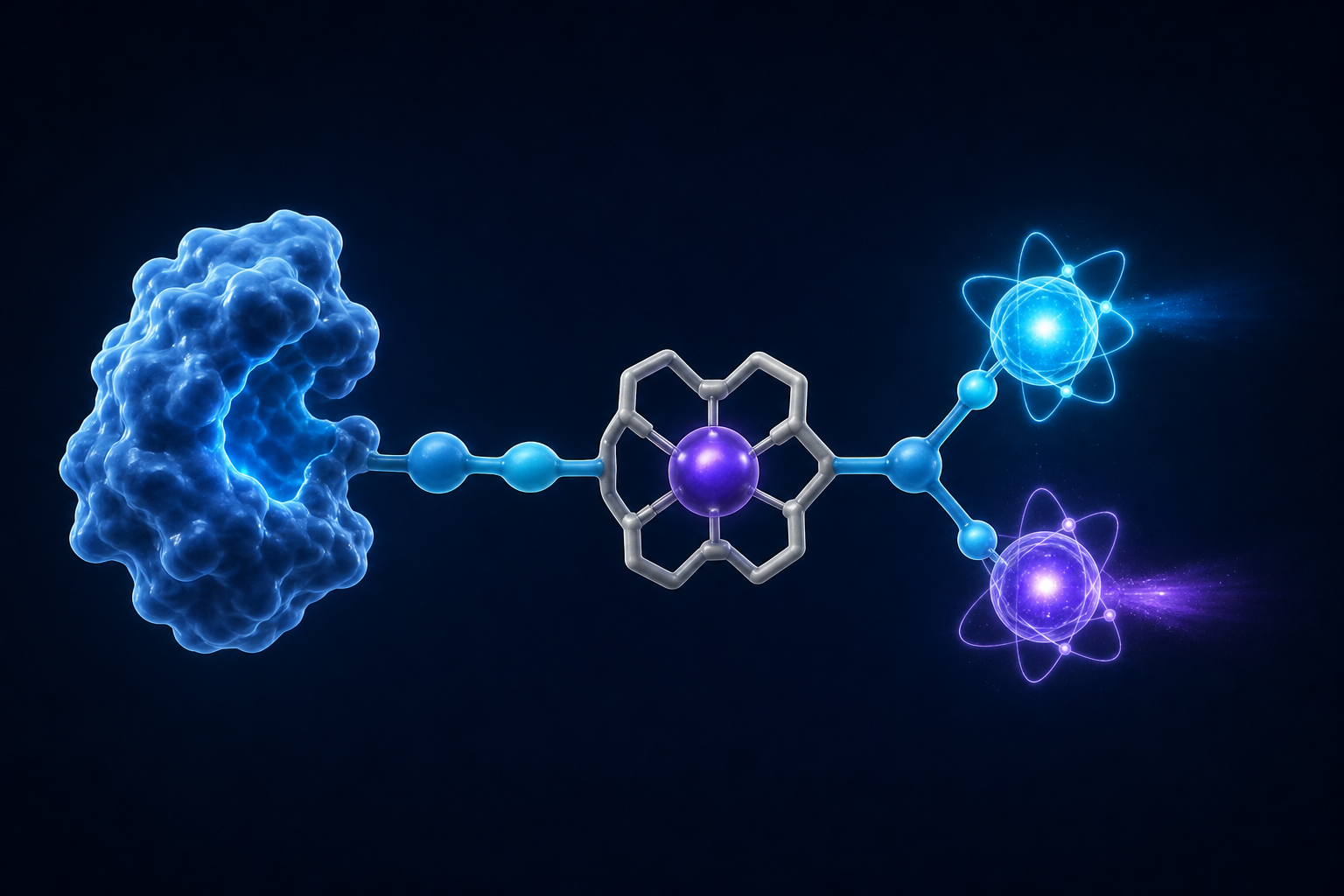
Theranostic Components — 03 · The Linker
The Linker
The connection that holds everything together — until the exact right moment.
If the radiopharmaceutical is a truck and trailer, the linker is the hitch: it must never let go in transit, and must let go cleanly on arrival.
Start here
What a linker is
Linker
A critical component of the radioligand that connects the ligand to the radioisotope. It determines the stability of the therapy while in circulation, prevents premature release of the radioisotope before it reaches the target, and provides efficient release once it arrives.
Where it fits
The linker is the hitch
In the truck analogy, the linker is the hitch — the connection between the truck and its trailer.
It sounds like a small part, but a hitch has one crucial job: hold everything together on a long, bumpy journey, and never let go at the wrong moment. If the hitch fails, the trailer — and its radioactive cargo — comes loose somewhere it shouldn’t.
The job
Hold on tight, then let go at the right moment
A good linker has to do two opposite things well, at two different times.
Stay stable in circulation
From the moment of injection until it reaches the tumor, the linker must hold the radioisotope firmly to the ligand. Any early release sends radiation into the bloodstream and healthy organs.
Release efficiently at the target
Once the drug arrives, the linker must let the payload act where it is needed. The chemistry is tuned so release happens at the tumor, not on the way there.
Why it matters
Same target, same isotope — different result
This is the part patients rarely hear: two drugs can share the same target and the same radioisotope, yet perform very differently — because they use different linkers.
A linker that releases its payload too early raises side effects and wastes dose. One that holds too tightly may never deliver. The linker is a quiet but decisive factor in whether a theranostic is both safe and effective.
Different pharmaceutical companies may use the very same target and isotope, but the outcome can change significantly depending on the linker. Every component matters — and the linker is one of the most underappreciated.
In practice
Different kinds of linkers
“Linker” is really a family of designs. Researchers choose or engineer one to solve a specific problem — reach the tumor faster, stay in the body longer, carry two targeting arms, or release only at the tumor. Here are the main types in use today, with real agents that use them.
Two targeting arms in one
A linker scaffold joins two copies of the targeting molecule instead of one, so the drug grips the cancer cell more strongly and stays on the tumor longer. Better retention can mean a higher dose to the cancer from fewer treatments.
Example: Clarity Pharmaceuticals’ SAR-bisPSMA links two PSMA-targeting peptides, paired with copper-64 for imaging and copper-67 for therapy in prostate cancer.
Hitching a ride in the blood
The linker carries a small tag that latches onto albumin, the most common protein in blood. This keeps the drug circulating longer, giving it more chances to reach and soak into the tumor — though it can raise dose to other organs, so it is a careful balance.
Example: PSMA-617 variants with an added albumin binder (such as IPBA) can deliver several times more dose to the tumor than PSMA-617 alone.
Release on arrival
These linkers are built to stay intact in the bloodstream but break apart under conditions found at or inside the tumor — or to be cleared cleanly by the kidneys. The goal is to protect healthy tissue in transit and reduce uptake in organs like the kidneys.
Example: Enzyme-cleavable sequences such as GYK and MVK have been used in PSMA agents to lower kidney dose.
Setting the right distance
The simplest linkers are spacers — short chemical chains (often PEG) that set the distance between the targeting molecule and the radioactive payload. Getting this length right helps the drug bind cleanly and clear at the right speed.
Example: Many first-generation radioligands use simple peptide or PEG spacers between the ligand and chelator.
These types are often combined — a single drug might use a bivalent design and an albumin binder. The linker is where a lot of the quiet innovation in this field is happening.
What’s coming
Smarter linkers
Cleavable linkers
Designed to break apart only under conditions found inside or around the tumor, so release is even more precise.
Stabilized chemistry
New bonds that resist breaking down in the bloodstream, cutting radiation to healthy tissue during transit.
Tunable release
Linkers engineered to control not just where, but how quickly the payload is delivered once it arrives.
Modular designs
Standardized linkers that let researchers swap ligands and isotopes more easily to test new combinations.
Keep going
The other components
The linker is one part of a molecule with several. Each one is chosen for a reason.
Share your feedback
Help us improve your experience