
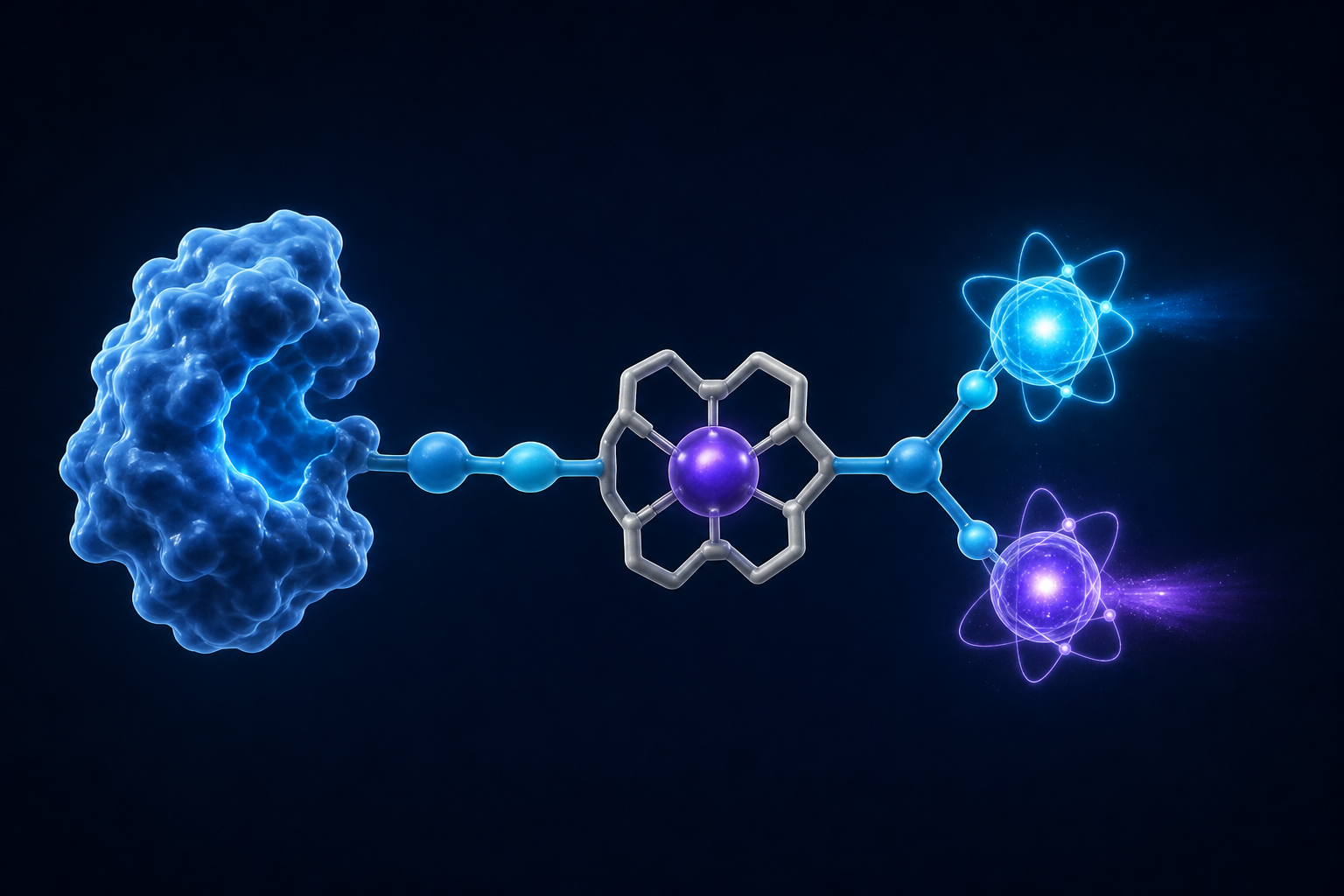
Alpha
Helium nuclei emitted from the atomic nucleus.
- Composition:
- Mass & Energy
- Utility:
- Therapeutic
- Energy:
- 5-30 MeV (HIGH)
- Range:
- <1mm (SHORT)
- DNA Damage:
- Double Stranded Breaks
- Hits to Kill Cell:
- 2-10
- Examples:
- Ac225, Pb212, Th227, At211, Ra223

 News Trial Stats
Mon–Thu 8am–4:30pm CT · Fri 8am–3pm CT
RLT Science
Radiation decay is the process by which unstable radioactive atoms give off energy to become stable. These decay modes power the radiopharmaceuticals used to image and treat cancer.
How each type of radiation works — and how it’s used.
Helium nuclei emitted from the atomic nucleus.
High-energy electrons emitted from the nucleus.
Very low-energy electrons released from the atom’s electron shells.
*Tb161 gives off both beta and Auger electrons. Auger electrons travel less than the width of one cell, so they work best when the drug reaches the cell’s DNA.
High-energy photons emitted from the nucleus.
Positively charged particles emitted from the nucleus.
Radioisotopes are the unstable atoms linked to a ligand delivery system and used to image or treat cancer, depending on each isotope's emission properties.
No isotopes match these filters.
Help us improve your experience